
Everyday Okinawa Between Naha's Tourist Spots: A Step-by-Step Plan for First-Time Group Trips, Built Around Street Karts
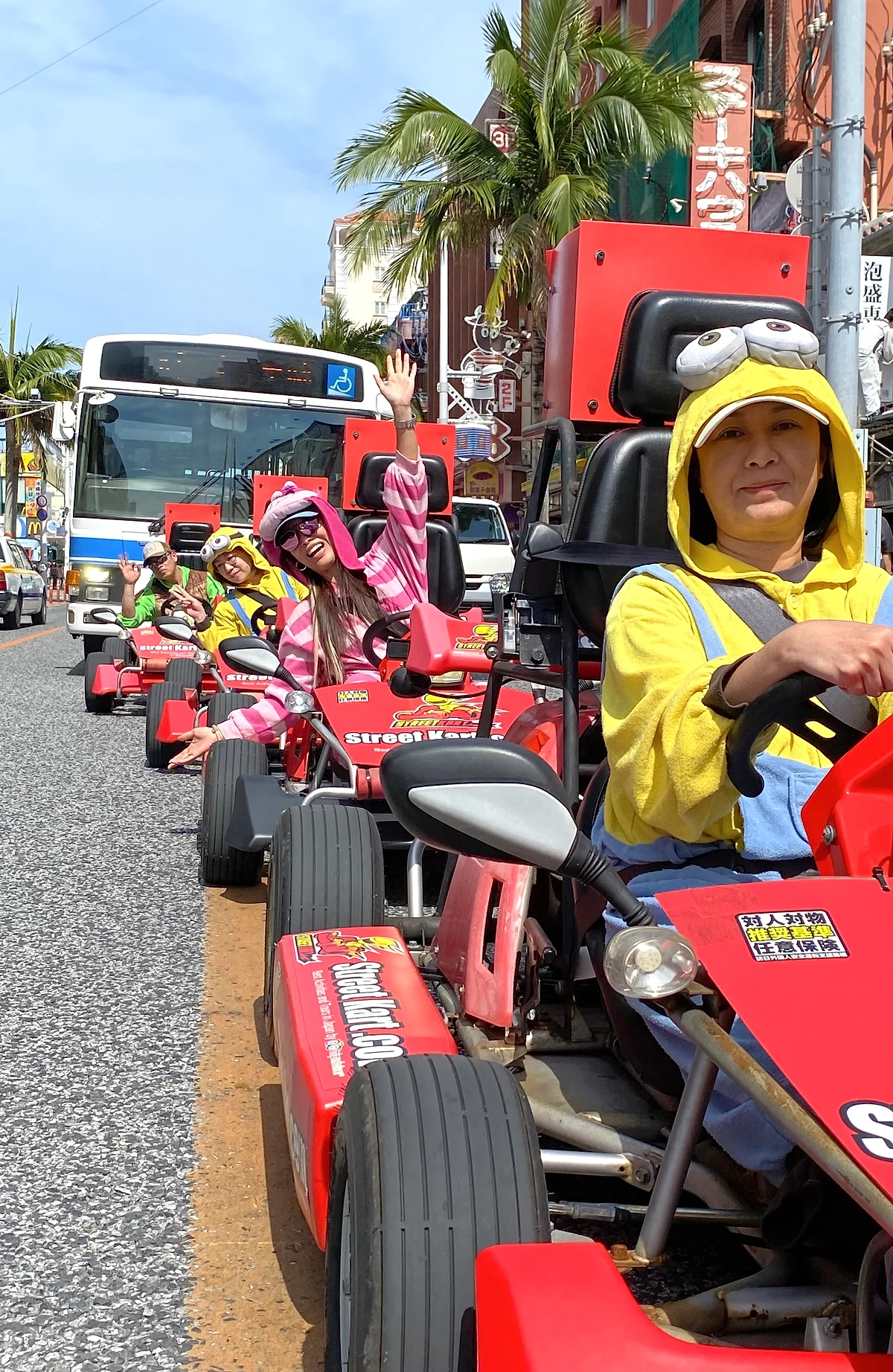
Everyday Okinawa Between Naha's Tourist Spots: A Step-by-Step Plan for First-Time Group Trips, Built Around Street Karts
Step one street off the crowds of Kokusai-dori and the sounds change. The souvenir shop barkers fade behind you. In their place come market voices asking prices a second time and the squeal of an old bicycle's brakes. The light changes too. Under the arcade roofs it was a hazy white, but in the alleys the building shadows cut it into sharp shapes. Maybe the best part of Naha isn't the famous sights themselves. Maybe it's the "ordinary city" that runs between one sight and the next.
On a trip with a group of friends, though, these side trips are usually the first thing to go. Someone wants to keep shopping, someone wants to see the ocean, and someone just wants to get back to the hotel and rest. Before the plan comes together, the sun is already going down. This article walks first-time group visitors to Naha through how to line up everyone's plans, one step at a time. At the center of the trip is a street kart tour that follows a guide through the streets of Naha.
Step 1: Find "the space between the tourist spots" on the map
Start by getting a picture of the whole area. Street Kart's Okinawa store is in Higashimachi, Naha City, and a lot of everyday Okinawa is within walking distance. Kokusai-dori is about a 10-minute walk from the store. The street runs for about 1.6 km, lined with souvenir shops and restaurants. It's Okinawa's main tourist street, sometimes called the "Miracle Mile."
Turn off it a little and even the humidity seems different. Makishi Public Market, on Kokusai-dori, is known as "Okinawa's kitchen" and is about a 10-minute walk from the store. It sells Okinawan ingredients, and you can have what you buy cooked for you on the second floor. These aren't display shelves set up for tourists. This is a market that feeds local dinner tables. Listen to conversations with bits of the island dialect mixed in, look at the blue of fish shining on ice and the knobbly shapes of fruit you've never seen before, and you'll find yourself walking a little slower.
Ichiba-Hondori is also about a 10-minute walk from the store. Go a bit farther, about 15 minutes on foot, and you'll reach Tsuboya Yachimun Street, known for its pottery. It's lined with pottery shops and cafés, and the glazes soften the afternoon light as they reflect it. The pace here is quiet, nothing like the bustle of Kokusai-dori.
Toward the ocean, Naminoue Beach is about a 20-minute walk away. It's a sandy beach right next to the city, with Naminoue Shrine standing close by. Tomari Iyumachi, also about 20 minutes on foot, has a fish market and casual restaurants, and it shows you Naha as a port town.
Office buildings, markets, and a beach, all close enough to walk between. Just checking that on a map makes planning a group trip much easier.
Step 2: Plan around the things that can't move
On trips with lots of people, the arguments usually aren't about what to do. They're about when and where to meet. So pick one fixed event first, then fit everything else around it. A street kart tour works well as that fixed event.
The first thing to know is that street karting is a guided tour: you follow a guide. According to the company's materials, the standard group is up to six drivers plus one guide. If your group is bigger, tell them your exact headcount and check on the official website how larger groups are handled and how groups are put together. Weekends tend to book up, so if you want to ride on a Saturday or Sunday, book early.
Second, check everyone's driver's license. The karts are single-seaters and can't carry passengers, so every person drives their own kart. Each person should check whether their own license qualifies on the driver's license information page. For details, including what to bring on the day, see the official website. If you leave this until just before the trip, one person might find out they can't ride, and the whole plan falls apart. Once you've set up the trip's group chat, make this the first thing you share.
Third, language. On tour day, the guidance is basically given in English. Whether you can get it in Japanese or another language depends on the staff that day, so it can't be guaranteed. If you have any concerns, contact them through the official website ahead of time.
Fourth, getting to the store. The store has no parking, and visitors are asked to come by public transport. When a group travels there separately, someone usually ends up running late. If you're staying near the store, for example at Hyatt Regency Naha Okinawa (about a 5-minute walk) or Okinawa Kariyushi Urban Resort Naha (about a 15-minute walk), meet in the lobby and walk over together. That alone makes the day a lot less hectic. There's a convenience store within a 5-minute walk of the store, so you can pick up drinks there before heading out. Naha Airport is about 15 minutes from the store by car. Before deciding whether to book the tour on your arrival day, line up everyone's flight arrival times. One delayed flight can be enough to break up the meeting plan.
Fifth, clothing and bags. The company recommends closed-toe shoes (sneakers are suggested) and clothes that are easy to move in. It asks riders to avoid open-toe shoes, heels, skirts, and dresses. If just one person brings only sandals because "it's a tropical island," you'll spend the morning of the tour hunting for shoes. Mention this in the chat before anyone packs. The store has lockers for small items, but they won't fit large luggage like suitcases. Leave big bags at your hotel before you meet up.
For groups, it's also worth sorting out payment in advance. According to the company's materials, the full amount is paid ahead of time via PayPal, and several people can pay separately through the same payment link. For whoever is organizing, not having to chase people for money after the trip makes a real difference. Check the payment details on the official website when you book.
Step 3: Everyday Naha from a kart's low seat
Once the basic plan is in place, it's time for the karts.
Before you drive off, you'll check in at the store and get a safety briefing that covers how to operate the kart, the route, and the rules to follow. Make sure everyone knows the arrival time given at booking so you're there in time for check-in and the briefing. Check the booking information for exactly when you need to arrive.
In a kart, your eyes sit much closer to the road. The kart has no suspension, so every seam in the asphalt comes straight up through the steering wheel into your palms. When a bus stops next to you at a red light, the low growl of its engine hums in your chest. The city moves past at about the waist height of people walking on the sidewalk. Wind slips past your neck, and the smell of something frying drifts out of a shop for a moment, then falls behind you. Sound, smell, and light all hit you directly, without even a pane of window glass in between.
The Okinawa store's tours include a route from Naha Airport to Kokusai-dori and a route that goes by way of Senagajima Island. The driving area covers central Naha, including Kokusai-dori, the area in front of the Prefectural Office, and Naha City Hall, along with roads by the sea. On Senagajima you'll find Umikaji Terrace, a shopping complex of white buildings, and around Naha Airport you may get to see planes taking off and landing up close. For the theme of this article, though, what's worth noticing is the scenery along the way. The pace of people crossing the intersection by the Prefectural Office, the shade of street trees falling on bus stops, the pale early-afternoon light. Everyday Naha, the kind you'd probably miss through a tour bus window, goes by right beside you.
One important point: the routes are set in advance. Even if you spot a side street that looks interesting, you can't turn down it. You follow the guide along the set route. For a group trip, that's actually a good thing. Nobody has to pull out a map and ask "which way now?", and everyone sees the same views in the same order.
It's natural to want photos and videos. Still, don't pick up your phone while driving. Take in the scenery with your eyes and your body, and save the souvenir photos for before and after the tour. While driving, follow your guide's instructions.
Step 4: Before and after the tour, walk into everyday life
Once the kart time is fixed, it becomes clear how to use the time before and after it. The trick with group trips is to decide from the start which time you'll spend all together and which time you'll split up.
Before the tour, a slow walk down Kokusai-dori with the whole group works well. Look into souvenir shops like Okashi Goten and Okinawaya, and everyone will get an idea of what they want to buy after the tour. Hold off on shopping until afterward, and head to the store with your hands free.
After the tour, try splitting into small teams by interest. The food lovers can pick ingredients at Makishi Public Market and have them cooked upstairs. The pottery fans can pick up pieces on Yachimun Street and feel how smooth the glaze is under their fingertips. Those who want to see the ocean can walk to Naminoue Beach and stand in a breeze thick with the smell of the sea. Then set a time to meet again at an easy-to-spot place on Kokusai-dori. This way, it's less likely that anyone ends up putting up with something just to keep someone else happy.
If some people get to the meeting spot early, they could grab ice cream at Blue Seal on Kokusai-dori while they wait. A cold bite tastes good when your cheeks are still warm from the wind on the kart ride. When everyone's together, each team can talk about the colors of the fish at the market or the weight of the pottery they held. Time spent in different parts of the same city comes together into one trip story.
If you want to go a bit farther, it's worth looking into the harbor-side restaurants at Tomari Iyumachi. But not everyone will have the same energy left. Driving for the first time takes more focus than you'd expect. Keep any long walks right after the tour to a comfortable amount.
One more thing to keep in mind when you visit places where people live. Markets and residential streets belong to the people who work and live there. Don't block the street with a big group, ask before you take photos, and take your trash with you. Walk that way, and you'll start to notice things on your own: conversations at shop fronts, the smell of water from the potted plants under the eaves.
Why people choose Street Kart
Here's a summary of Street Kart's features, from the point of view of planning for a group.
First, every tour is led by a trained guide. Even on Naha roads you've never driven, you just follow the guide. Nobody has to be stuck with memorizing the route, which takes a lot of pressure off the organizer.
Second, the routes are set in advance. Not being able to drive anywhere you like might sound limiting. But the bigger the group, the more you'll appreciate not spending time arguing about where to go. It also makes the rest of the day easier to plan.
Third, their track record. As of November 2023, across all stores combined, they had run more than 150,000 tours, served more than 1.34 million customers, and collected more than 20,000 reviews, with an average rating of 4.9 out of 5. If someone in your group is nervous about trying something new, sharing these numbers might help.
Fourth, the website is available in 22 languages. Guidance on tour day is basically in English, but you can read the website in any of the 22 languages it offers.
Fifth, cancellation is free up to 7 days in advance. On a big group trip, someone's plans may change at the last minute. For details on cancellation and change conditions, check the latest information on the official website.
Sixth, tours go ahead as planned in light to moderate rain, and raincoats are provided free of charge. Tours are canceled in heavy rain or typhoons. For weather-related decisions, follow the guidance on the official website.
Seventh, the store is right in the middle of Naha. Kokusai-dori and Makishi Public Market are each about a 10-minute walk away. You can retrace on foot the streets that went by while you were in the kart.
Final steps: Get in touch early, and check details on the official website
Looking back over all this, the steps are simple. First, have everyone check their driver's license. Next, ask about a booking and include your headcount. Then decide on a meeting place and how you'll get there. Last, pick where the small teams will meet back up after the tour. Do it in this order, and on the day you'll spend less time figuring out who's doing what, and more time looking at Naha.
Bookings are taken through Facebook, LINE, and email. Contact details are on the Street Kart official website. Prices change depending on the season and time of day, so check the latest prices on the official website (kart.st). Weekends tend to book up, so as soon as the dates are settled in your group chat, get in touch.
The buzz of Kokusai-dori, the voices in the market, and the waves on the beach. In Naha, all three are within walking distance of each other. Seen from close to the road, even the small things in between stay with you: the light at an ordinary intersection, the moving shadows of street trees. Some time after you get home, they'll probably come back to you, along with the faint vibration of the road through the steering wheel.
This article was originally written in Japanese and translated using AI. Some expressions may read unnaturally, and we appreciate your understanding. For the most accurate and up-to-date information, please refer to the official site at kart.st.
Street Kart is not affiliated with Nintendo or the Mario Kart series in any way. We do not provide costumes of Nintendo characters, and such costumes may not be worn during tours even if brought by participants.